

Editors
- Editor in Chief
- Andrew Nafalski
- Vice Editor in Chief
- Aji Prasetya Wibawa
Knowledge Engineering and Data Science (2597-4637), KEDS, brings together researchers, industry practitioners, and potential users, to promote collaborations, exchange ideas and practices, discuss new opportunities, and investigate analytics frameworks on data-driven and knowledge base systems. KEDS is published by depatment of Electrical Engineering and Informatics, Unversitas Negeri Malang.
The journal welcomes experimental and theoretical findings on data science and knowledge engineering along with their applications to real-life situations. Comprehensive surveys and book reviews are also welcome. KEDS publishes two series peryear of scientific articles in every 6 months (July, December). Before submission, you have to make sure that your paper is prepared using the journal paper template: 2017_KEDS_Template.DOC.
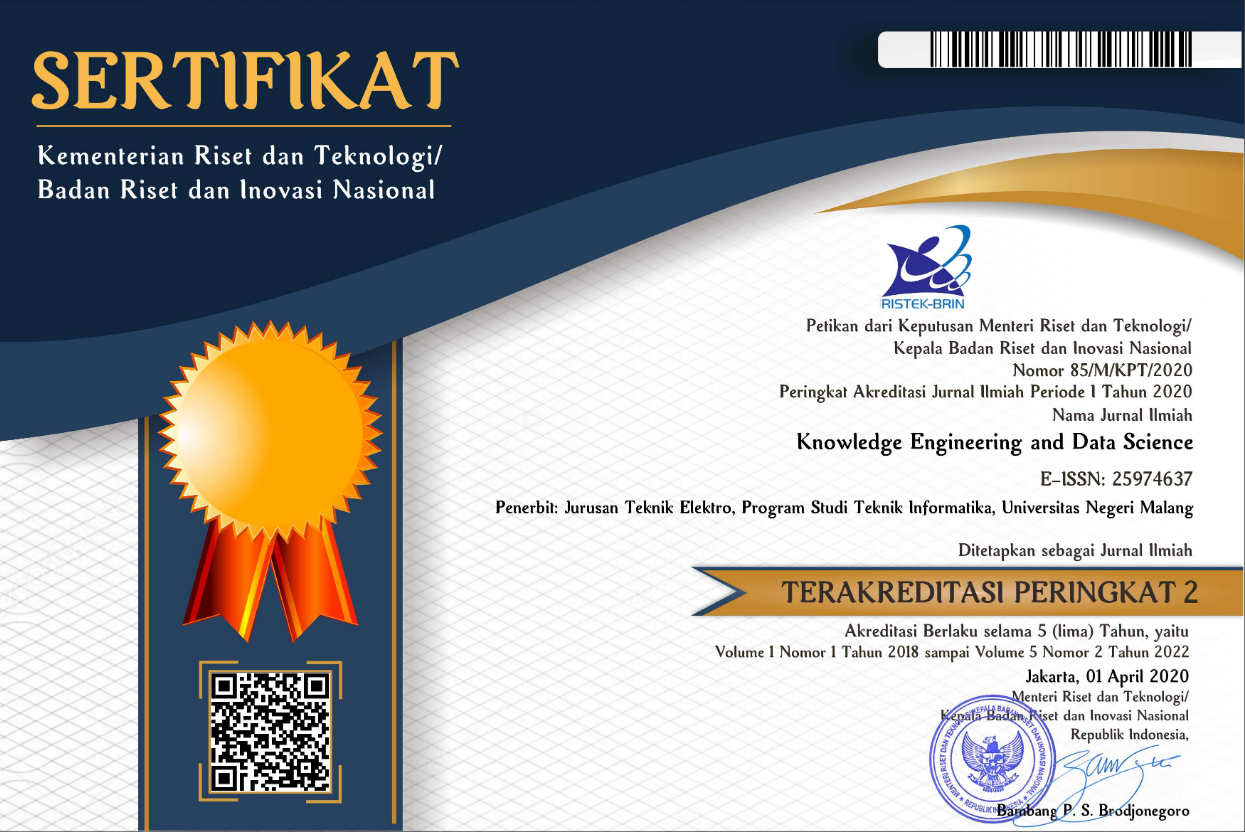
This journal has been accredited Rank 2 (peringkat 2) as a scientific journal under the decree of the Ministry of Education, Culture, Research, and Technology of the Republic of Indonesia (valid until Vol. 10, No 2, 2027)
|
Time to First Decision |
Review Time |
Publication Time |
Current Issue: Volume 8, Number 1 (2025)
Articles
Spatial Analysis and Machine Learning Integration for Nutritional Status Mapping Using ANN and Random Forest Models
Desi Anis Anggraini, Fachrul Kurniawan, Fresy Nugroho, Meidya Koeshardianto, and Mohammad Iqbal Bachtiar
https://doi.org/https://doi.org/10.17977/um018v8i12025p1-15
pp. 1 - 15Time Series Forecasting with LSTM: an extensive content analysis
Andri Pranolo, Xiaofeng Zhou, and Yingchi Mao
https://doi.org/https://doi.org/10.17977/um018v8i12025p16-50
pp. 16 - 50From Data to Insight: A Machine Learning Approach in Classifying Dairy Cow Productivity Level and Identifying Important Influencing Variables
Fatkhurokhman Fauzi, Achmad Fauzan, Rhendy K P Widiyanto, Khairil Anwar Notodiputro, and Bagus Sartono
https://doi.org/https://doi.org/10.17977/um018v8i12025p51-67
pp. 51 - 67Classification of Indonesian Sign Language (SIBI) Using Data Mining Algorithms K-Nearest Neighbor and Random Forest
Muhammad Zaki Wirawan, Achmad Afif, Anik Nur Handayani, Imanuel Hitipeuw, and Osamu Fukuda
https://doi.org/https://doi.org/10.17977/um018v8i12025p68-80
pp. 68 - 80A Hybrid Soft Voting and Stacking-Based Meta-Learning Approach for Sentiment Analysis of Bangkalan Batik
Moh. Imron Wahyudi, Lailil Muflikhah, and Rizal Setya Perdana
https://doi.org/https://doi.org/10.17977/um018v8i12025p81-91
pp. 81 - 91Prediction of Audit Findings Using Deep Learning with Financial and Non-Financial Data: A Case Study in Province X
Fery Yohan Setiawan, Eko Mulyanto Yuniarno, and Reza Fuad Rachmadi
https://doi.org/https://doi.org/10.17977/um018v8i12025p92-103
pp. 92 - 103A Comparative Study of Machine Learning Models for Javanese Wuku Classification: Exploring SVM, Naïve Bayes, and CNN for Cultural Texts
Danang Arbian Sulistyo, Aji Prasetya Wibawa, Didik Dwi Prasetya, Fadhli Almu'iini Ahda, and Agung Bella Putra Utama
https://doi.org/https://doi.org/10.17977/um018v8i12025p104-117
pp. 104 - 117

